Add-on · Aurrora · 2025
Vehicles
23 drivable vehicles and a full road-sign system. I produced it from docs to Marketplace release.
Overview
23 vehicles, one road-sign system and 279 pieces of content.
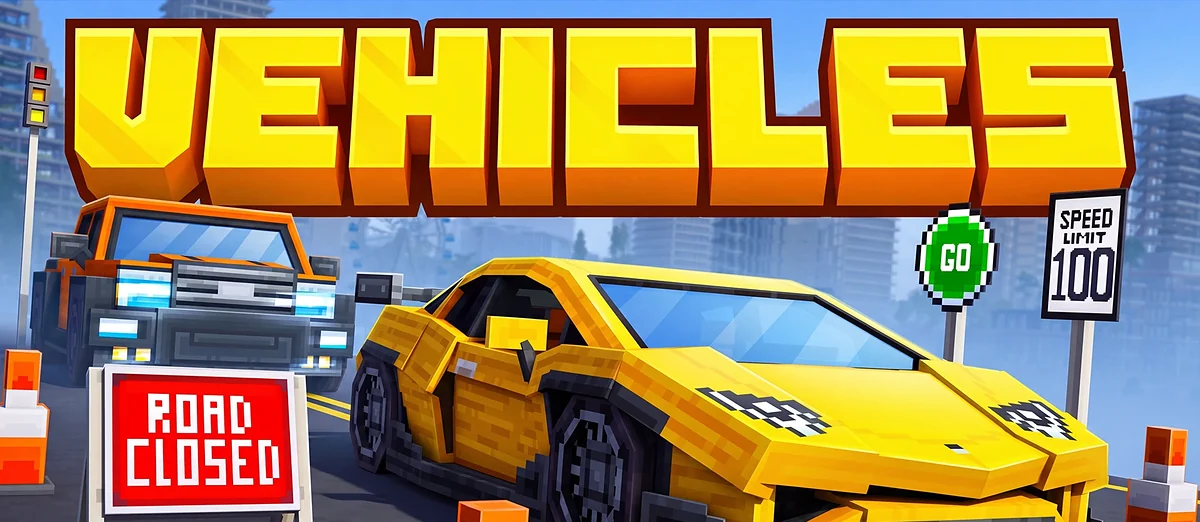
Vehicles is an Aurrora add-on for the Bedrock Marketplace. Players can drive, ride, sail and fly 23 vehicles, from sports cars and an F1 car to a banana car and a UFO. A road-sign system covers the streets they drive on. I produced it as Executive Producer.
The hard part was the amount of content, not any one feature. Every vehicle needed a model, textures, sounds, particles, item icons and crafting. So the first job was to get it all written down before anyone started building.
My role
Producer, from doc to release.
- Project docs. Wrote the overview, objectives, scope, and the functional requirements and acceptance criteria the team built and tested against.
- Content guide. Documented every entity, item, block, sign, particle and sound for the team and for Microsoft's reviewers.
- Crafting design. Designed the recipes for all 23 vehicles and the tools.
- Delivery. Briefed art, animation and dev, ran QA rounds and took the pack through review.
- Not the code. I'm a producer, not a developer. The scripting and the texture-memory fix were the lead developer's work.
The roster
Six groups, so the list stays readable.
I grouped the vehicles by where they go: road, off-road, emergency, novelty, water and air. Hover a tile to take it for a spin.
Icons drawn for this page. In game, every vehicle has its own Blockbench model and textures.
Content, counted
Writing it all down first.
I counted and named every piece before production started, so art, dev and QA all worked from the same list. Signs were the biggest group by far, because a road system needs a lot of them.
Plus a sound set for every vehicle: start-up, idle, engine and rev.
Systems
A vehicle hotbar that gives your items back.
When you get in, your hotbar is saved and swapped for vehicle controls: horn, radio, camera, headlights and doors. When you get out, your items come back exactly as they were. Try it.
Your normal hotbar.
Doors
Each door has its own icon and closes again on its own.
Radio and camera
Three radio tracks, and a button that cycles the camera view.
Headlights
A Headlight block lights the road in front of the vehicle.
Tools
Performance
Splitting the textures to fit the memory limit.
With Vibrant Visuals on, the full set of textures went over the texture-memory limit. Lowering everything would have made the vehicles look worse for every player. Our lead developer proposed and built the fix: a base pack that always fits and an optional high-res subpack. My part was agreeing the trade-off, getting it into the docs and making sure QA tested both packs.
Diagram only, bar lengths not to scale.
Scope and QA
Clear rules for what the pack does, and what it doesn't.
Every goal in the brief was linked to success criteria, then to functional requirements, then to acceptance criteria that QA could tick off. Fuel, damage, weapons and upgrades were written down as out of scope on day one, so they never came up again halfway through the build.
OBJ7ObjectivesSC6Success criteriaFR22Functional requirementsAC25Acceptance criteriaQA covered solo, 2-player and 4-player sessions on every platform, plus a pass on edge cases.
Thought process
- 01
Document before building
A list of 279 pieces turns into missed work fast. Counting and naming everything first meant nothing was skipped and QA had a checklist on day one.
- 02
Give the hotbar back
Vehicle controls take over the hotbar, so the player's own items are saved on the way in and restored on the way out. Nothing gets lost.
- 03
Split textures, don't downgrade them
The lead dev's base pack plus optional high-res subpack kept the pack within the memory limit without making it look worse. I'm not a developer, so my job was to back the right call and document it.
- 04
Say no early
Fuel, damage, weapons and upgrades were cut on paper before production started. That kept the team on what makes vehicles fun.